
Fairfax County Reckless Driving
Charged with reckless driving in Fairfax County? It is a criminal charge, not a ticket — and the courthouse you report to matters more than most people realize.
Call Ervin Law PLLC: 703-962-7790
| Fairfax County Reckless Driving
Almost every reckless driving charge in Fairfax County starts the same way. Someone gets pulled over on the Beltway, or on 66 near the Nutley interchange, or on the Fairfax County Parkway at seven in the morning. The officer is polite. The stop takes eight minutes. The driver goes home, looks at the summons, sees a court date instead of a dollar amount, and assumes there’s been some kind of clerical mistake.
There hasn’t been. Virginia Code § 46.2-862 makes it reckless driving to travel 20 mph or more over the posted limit, or to exceed 85 mph regardless of what the limit is. That second prong gets all the attention. In Fairfax County, it’s usually the first one that gets you.
Here’s why. The 85 mph rule matters on rural stretches of I-81 and I-95 south of Fredericksburg, where limits run to 70. Nothing in Fairfax County is posted anywhere near that. On a 55 mph road — which describes most of the limited-access pavement in this county — you are committing a Class 1 misdemeanor at 75. That is a speed that thousands of drivers hit every afternoon without thinking about it, in the left lane, keeping up with traffic. The gap between “I was going with the flow” and “I was charged with a crime” is genuinely that narrow here.
So when someone tells me they were “only” 18 over, I understand the instinct. But the statute doesn’t grade on a curve, and neither does the record it leaves behind.
| First, make sure you know which courthouse you're going to
This trips up more people than any other single thing, and it costs them a failure to appear on top of the reckless charge.
“Fairfax” is not one court. There are four places your case might be heard, depending on which agency wrote your summons and where the stop happened:
- Fairfax County General District Court — 4110 Chain Bridge Road, Fairfax, VA 22030. This is where the overwhelming majority of county reckless driving cases land, including anything written by Fairfax County Police or Virginia State Police on the interstates.
- City of Fairfax General District Court — 10455 Armstrong Street. A separate court with its own clerk, its own docket, and its own policies. The City of Fairfax is an independent city surrounded by the county. If City of Fairfax Police stopped you, you are going to Armstrong Street, not Chain Bridge Road, even though the two are a few minutes apart.
- Town of Vienna cases — the Fairfax County clerk handles these, but court is held at the Vienna division on Center Street South. Vienna hears misdemeanor and traffic Mondays at 9:00 AM
- Town of Herndon cases — same arrangement, with court held on Lynn Street in Herndon. Herndon hears them Wednesdays at 9:00 AM
Read the top of your summons. It names the court. If you show up at the wrong building, nobody will walk you across town, and the docket will be called without you.
A practical note on the main courthouse: parking is a real problem. Garage B on Page Avenue runs about $2 per hour with a daily cap, and it is a solid walk plus a security line before you’re anywhere near a courtroom. Give yourself forty-five minutes. I have watched people lose good cases because they arrived flustered at 9:04 for a 9:00 docket.
Let’s connect
Reach out with your queries and get a quote
Reckless Driving Topics
- Arlington Virginia Reckless Driving: Laws, Penalties, and How to Defend Against Charges
- Cost of a Reckless Driving Lawyer in Virginia
- Do I Need a Fairfax Reckless Driving Attorney? Understanding Your Legal Options and Next Steps
- Do I Need a Reckless Driving Attorney? Key Reasons to Hire a Lawyer in Northern Virginia
- Driving Too Fast for Traffic Conditions (46.2-861): Virginia Penalties, Defenses & Legal Advice
- Driving Two Abreast in a Single Lane (46.2-857): Virginia Law, Penalties, and Legal Defense
- Driving When View is Obstructed (46.2-855) / Car Overloaded (46.2-855): Laws & Penalties
- Failing to Give Proper Signals (46.2-860): Understanding Reckless Driving Charges in Virginia
- Fairfax Reckless Driving Lawyer
- Fairfax Speeding Ticket Lawyer
- Fighting a Reckless Driving Charge in Northern Virginia: Radar, Lidar, Pacing & Legal Strategies
- First Offense Reckless Driving in Fairfax: Penalties, Laws, and Legal Defense Options
- How Much Is a Reckless Driving Ticket in Virginia? Costs, Fines & Penalties Explained
- How to Beat a Reckless Driving Ticket in Virginia: Proven Legal Strategies for Your Defense
- How to Help Your Lawyer Get a Reckless Driving Charge Dismissed or Reduced in Virginia
- Improper Control or Driving with Faulty Brakes (46.2-853): Penalties, Defenses, and Legal Help
- Loudoun Reckless Driving Lawyer: Expert Defense for Virginia Reckless Driving Charges
- Occoquan Speeding Ticket Lawyer
- Penalties for Fairfax County Reckless Driving Charges: Fines, Jail Time & Lasting Consequences
- Racing (46.2-865): Understanding Virginia’s Racing Laws, Penalties, and Legal Defense Options
- Reckless Driving by Speed in Fairfax: Laws, Penalties, and Legal Defense Strategies
- Reckless Driving for Failure to Yield to Emergency Vehicles (Virginia Move Over Law): What to Know
- Reckless Driving for Passing a Stopped School Bus: Laws, Penalties, and Legal Defense in Virginia
- Reckless Driving in Prince William County: Laws, Penalties, and Legal Defense Options
- Reckless Driving in Virginia: What You Need to Know (And Why You Shouldn’t Face It Alone)
- Should I Get A Speedometer Calibration For A Reckless Driving Charge In Virginia? Facts & Tips
Types of Reckless Driving
Driving 20 MPH over the limit
Driving over 85 MPH
Up to 12 months in jail, a fine up to $2,500, or both
Six DMV demerit points
Driver’s license suspension up to six months
Eleven years on your Virginia driving record — and a criminal conviction that does not expire on its own
| What a conviction actually does in Northern Virginia
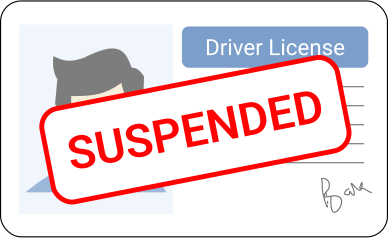
Every traffic lawyer’s website lists the statutory maximums: up to 12 months in jail, up to a $2,500 fine, up to a six-month license suspension, six DMV demerit points, and the conviction sitting on your Virginia driving record for eleven years.
Those numbers are accurate. They are also not the reason most of my clients call.
The reason most of them call is that they work at Fort Belvoir, or for a prime contractor in Tysons, or at an agency in McLean, and someone in their office once mentioned that a misdemeanor is a reportable event.
That person was right. And here’s the specific mechanism, because the detail matters:
The SF-86 lets you skip traffic infractions where the fine was under $300 and no drugs or alcohol were involved. That carve-out is why nobody discloses a speeding ticket. Reckless driving does not fit inside it — not because of the fine amount, but because reckless driving is not an infraction. It is a Class 1 misdemeanor, and it comes with a summons to appear in a criminal proceeding.
That single classification difference is why a reduction from reckless driving to improper driving under § 46.2-869 is worth so much more here than it looks like on paper. Improper driving is a traffic infraction. It carries three demerit points instead of six, a maximum fine of $500, and no criminal conviction at all. If the case resolves that way and the fine comes in under $300, you may be looking at a disposition that changes the analysis considerably.
I want to be careful here, because this is exactly the kind of thing people over-read. Continuous vetting, your FSO’s internal reporting rules, and agency-specific questionnaires can all impose obligations that are broader than the SF-86 itself. If you hold a clearance, the answer to “should I disclose?” is almost always yes, and you should ask your security officer rather than your traffic lawyer. Candor problems sink far more clearances than driving records do. But the classification of your disposition is something we can actually fight about in court, and it’s worth fighting about.
The same logic applies with even less flexibility if you hold a CDL. Federal rules bar states from masking serious traffic violations for commercial drivers, and reckless driving is one of them. If you drive for a living, tell me on the first call.
| The 2026 sealing law is not the safety net people think it is
Virginia’s Clean Slate law took effect on July 1, 2026, and it has changed the conversation about criminal records in a real way. It’s also being widely misunderstood, so let me be direct about how it applies here.
If your charge is dismissed or you’re acquitted: that non-conviction is now generally sealed automatically at the conclusion of the case. This is a genuine improvement and it is a strong argument for fighting a case you might once have been tempted to concede.
If you’re convicted of reckless driving: the offense is not on the statute’s list of categorically excluded crimes — those exclusions center on DUI and certain assault and vehicular offenses — so a reckless driving conviction is generally eligible for petition-based sealing under § 19.2-392.12. Emphasis on petition. That means a seven-year waiting period, a clean record throughout, a filing in Circuit Court, and a judge who has discretion to say no.
Three things that seven-year timeline does not fix:
- Your DMV record is separate. Sealing addresses criminal history record information and court records. It does not reach into your Virginia driving transcript, where the conviction sits for eleven years and your insurer can see it.
- The SF-86 asks about sealed and expunged records anyway. Sealing is not an answer to a federal background investigation.
- Seven years is seven years. It is the wrong plan for a job you’re interviewing for in the fall.
Sealing is a repair mechanism. It is not a reason to walk into court alone.
| What a Reckless Driving Lawyer Can Do For Your Case
Not every one of these cases is a trial. Most aren’t. The honest description of the work is closer to this:
I read the case before I read the client’s explanation of it. The summons, the specific code section, the alleged speed, the method of measurement, the location, the time, the weather, the officer’s agency. Radar, lidar, and pacing each have different calibration and foundation requirements, and each fails in different ways. Whether there’s a real evidentiary issue is a question the paperwork answers, not the story.
I tell you early if there isn’t one. Some cases are clean stops with solid numbers. When that’s true, saying so is more useful than pretending otherwise, and it changes the strategy from contesting the charge to building the strongest possible mitigation package before your date.
I handle the negotiation. In Fairfax, a represented defendant is in a different posture than an unrepresented one, and there is no version of the docket where a driver standing at the podium alone has the same conversation with the Commonwealth that counsel does.
I prepare you for the actual room. Which courtroom, what time to arrive, what to wear, what the judge will ask, what to say when they do, and — more importantly — what not to volunteer. A surprising number of convictions in that building are self-inflicted during the thirty seconds a defendant spends explaining themselves.
What to do in the next two weeks, whether or not you hire anyone
Time is the resource you have the most of right now and will have the least of later. Use it.
- Get a speedometer calibration. Do it soon, while the reading still reflects the tires and condition of the car on the date of the stop. Waiting until the week before court undercuts the whole point of the document.
- Pull your own driving record from DMV. Do not guess at what’s on it. I have had clients confidently describe a spotless record that turned out to have a violation on it from a state they’d forgotten they were licensed in.
- Complete a driver improvement clinic. A DMV-approved course adds safe driving points and, more usefully, demonstrates to the court that you took the charge seriously before someone made you.
- Write down what you remember now. Traffic, weather, lane position, whether other cars were around you, where the officer was, how long before the lights came on. In four months you will remember none of it.
- Do not post about it. This should not need saying. It does.
- Take photographs of the location if there’s anything unusual about it — signage, construction, a limit that changes mid-stretch.
If you gather nothing else, gather the calibration and the driving record. Those two documents do more work in that courthouse than most people expect.

Let’s connect
Reach out with your queries and get a quote
